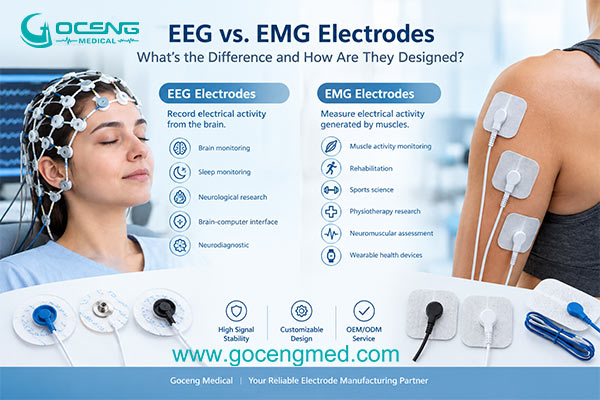
EEG and EMG electrodes are both used to collect electrical signals from the human body, but they are designed for different applications.
EEG (electroencephalography) records electrical activity associated with the brain, while EMG (electromyography) measures electrical activity generated by muscles.
For medical device manufacturers and developers, understanding the differences between these two electrode types is important when selecting the right electrode construction for a new device.
1. EEG Electrodes: Designed for Brain Signal Acquisition
EEG electrodes are used to detect very small electrical signals from the scalp.
They are commonly used in:
- EEG monitoring systems
- Sleep monitoring equipment
- Neurological research
- Brain-computer interface development
- Neurodiagnostic applications
Because EEG signals can be relatively low in amplitude, the electrode-skin interface is particularly important. Stable contact and reliable signal acquisition are key considerations during electrode development.
EEG electrodes may use different conductive materials and structures depending on whether they are designed for short-term clinical monitoring, long-term recording, research, or wearable applications.
2. EMG Electrodes: Designed for Muscle Activity Monitoring
EMG electrodes detect electrical activity generated by muscles.
Typical applications include:
- Muscle activity monitoring
- Rehabilitation equipment
- Sports science
- Physiotherapy research
- Neuromuscular assessment
- Wearable health devices
Compared with EEG applications, EMG electrodes are often positioned on or near specific muscle groups. Therefore, electrode size, flexibility, adhesion, and the ability to maintain stable contact during movement can be important design considerations.
For wearable and rehabilitation applications, the electrode may also need to conform closely to the body while maintaining consistent electrical contact.
3. EEG and EMG Electrodes Are Not Simply Interchangeable
Although both electrode types collect biological electrical signals, the requirements of the application can be quite different.
| Feature | EEG Electrode | EMG Electrode |
|---|---|---|
| Main signal | Brain electrical activity | Muscle electrical activity |
| Typical location | Scalp | Muscle area / skin surface |
| Common applications | Brain and sleep monitoring | Muscle and rehabilitation monitoring |
| Key design focus | Stable low-level signal acquisition | Stable contact during muscle movement |
| Electrode design | Often optimized for scalp contact | Often optimized for body movement |
| Typical development | Medical, research, wearable | Medical, rehabilitation, sports, wearable |
This does not mean that one electrode construction is automatically suitable for every EEG or EMG application. The electrode should be selected according to the complete device design and intended use.
4. The Electrode-Skin Interface Matters
For both EEG and surface EMG, the electrode forms an interface between the electronic system and the human body.
Several factors can influence this interface, including:
- Conductive material
- Conductive medium
- Electrode surface area
- Backing material
- Adhesive construction
- Flexibility
- Skin contact stability
- Connector configuration
A suitable construction needs to balance electrical performance with mechanical comfort and practical usability.
For example, a wearable EMG system may require a flexible electrode that can remain in contact with the skin while the user moves. An EEG application may place greater emphasis on stable scalp contact and signal acquisition over a longer monitoring period.
5. Disposable and Reusable Designs
EEG and EMG electrodes can be developed in different formats depending on the application.
Disposable electrodes are commonly considered when hygiene, convenience, and quick application are priorities.
Reusable electrodes may be selected for applications where repeated measurements are required and the device is designed for cleaning and reuse.
The appropriate solution depends on the device architecture, intended use, regulatory requirements, and user workflow.
6. Customization Is Often Part of the Development Process
There is no universal electrode specification for every EEG or EMG device.
During product development, manufacturers may need to customize:
- Electrode diameter or dimensions
- Shape
- Conductive area
- Backing material
- Adhesive
- Connector or snap type
- Cable or lead configuration
- Packaging format
For wearable devices in particular, the electrode may need to fit a specific housing, sensor position, or body contour.
This makes early communication between the device developer and electrode manufacturer important. Providing the electrode dimensions, application, connector requirements, expected use duration, and target body area can help determine the most suitable construction.
Conclusion
EEG and EMG electrodes may look similar at first glance, but they serve different signal-acquisition applications and can require different design considerations.
EEG focuses on acquiring brain-related electrical signals, while EMG focuses on muscle electrical activity.
For medical device manufacturers, research institutions, rehabilitation equipment developers, and wearable technology companies, choosing the appropriate electrode construction can be an important part of the overall product design.
At Goceng Medical, we provide customized electrode solutions for EEG, EMG, ECG, TENS and other biomedical applications. Our OEM/ODM capabilities allow electrode dimensions, conductive areas, backing materials, connectors, and other construction details to be developed according to specific device requirements.
The right electrode is not simply a conductive component — it is an important interface between the human body and the device.