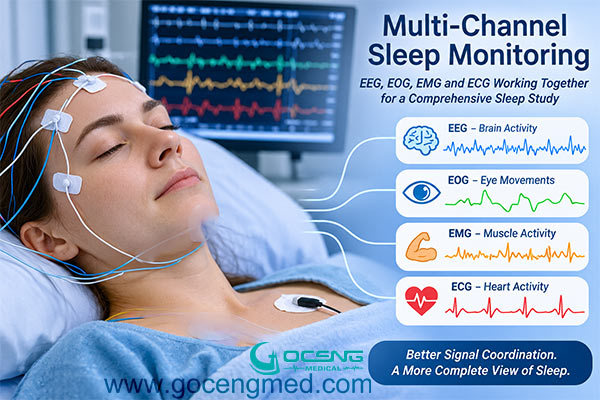
Sleep monitoring involves more than recording brain activity. In clinical sleep studies, multiple physiological signals are collected and analyzed together to help healthcare professionals understand sleep stages, body movements, breathing patterns, and related events throughout the night.
As sleep research and diagnostic technologies continue to develop, the coordination of different recording channels remains an important consideration in polysomnography (PSG) system design.
Understanding the Role of Different Recording Channels
A comprehensive sleep study may combine several types of physiological signals, each providing different information about the patient's sleep.
- Electroencephalography (EEG): Records electrical activity of the brain and provides key information for sleep-stage assessment.
- Electrooculography (EOG): Detects eye movements, which help distinguish sleep stages and identify characteristic patterns during rapid eye movement (REM) sleep.
- Electromyography (EMG): Measures muscle activity, including chin muscle activity and limb movements, depending on the monitoring application.
- Electrocardiography (ECG): Records cardiac electrical activity to support the assessment of heart rate and rhythm during sleep.
When these signals are recorded in a coordinated manner, clinicians can evaluate sleep-related events from multiple physiological perspectives rather than relying on a single signal source.
Why Signal Compatibility Matters in Sleep Study Design
Different recording channels have different technical requirements. Electrode selection, placement, connector compatibility, and acquisition-system configuration must be considered according to the intended application.
For EEG and EOG recordings, the electrode configuration must support the required recording locations and channel arrangement. EMG applications may require different electrode sizes, shapes, or placement configurations depending on the muscles being monitored.
In multi-channel systems, compatibility between electrodes, lead wires, connectors, and recording equipment is also important. A well-planned configuration helps laboratories establish consistent recording procedures and simplifies equipment setup across different studies.
These considerations are particularly relevant to manufacturers and system integrators developing sleep-monitoring equipment for clinical laboratories, hospitals, and research environments.
Supporting Different Sleep Monitoring Applications
Sleep monitoring systems are used in a range of applications, from routine sleep assessments to specialized investigations of sleep-related movement and neurological events.
For manufacturers developing these systems, electrode requirements may vary according to the number of recording channels, the intended placement sites, the monitoring protocol, and the design of the associated equipment.
Disposable electrodes, reusable sensors, and customized electrode configurations may each be suitable for different applications. Selection should be based on the system's technical requirements, applicable clinical protocols, and relevant regulatory considerations.
Goceng Medical: Electrode Solutions for Physiological Signal Acquisition
Goceng Medical supplies medical electrode products for physiological signal acquisition, including EEG-related and other electrode applications. We understand that equipment manufacturers and distributors may require different electrode configurations to match their system designs and intended uses.
Our team supports product discussions covering electrode dimensions, connector configurations, materials, and OEM customization requirements, subject to product feasibility and applicable specifications.
For companies developing sleep-monitoring systems or sourcing electrodes for physiological recording applications, early communication about channel requirements and equipment compatibility can help establish a more suitable product specification.
Contact Goceng Medical to discuss electrode requirements for your sleep-monitoring or physiological signal acquisition projects.